Thursday, June 20, 2019

One Man Show

One man show

In long run, BJP’s dependence on PM Modi can hurt the party, contribute to erosion of federalism
Narendra Modi, Modi BJP, BJP Modi, BJP Narendra Modi, Narendra Modi BJP, BJP 2019 elections, Amit Shah, BJP federalism, Indian Express, latest news
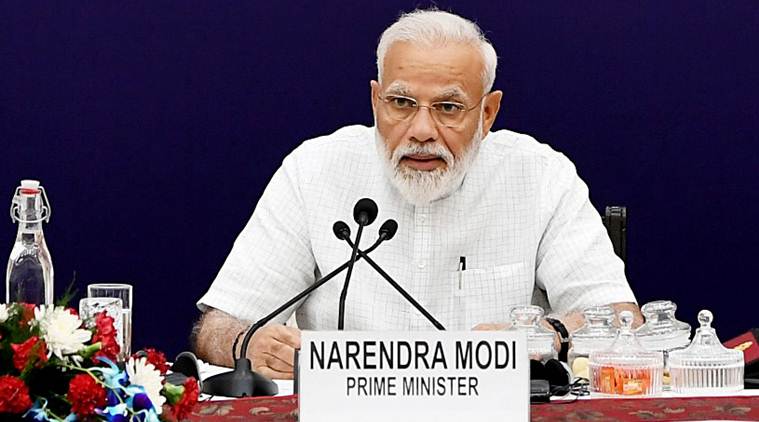
Not only are most of the BJP candidates selected by Modi and Amit Shah, but they depend upon the duo after becoming MPs. (ANI)
The just-concluded Lok Sabha elections were won by Narendra Modi, not the BJP. This is evident from the exit poll conducted by Lokniti-CSDS, which shows that one-third of the BJP voters would have chosen a different party had Modi not been the PM candidate. This state of affairs — typical of the populist scenario spreading across the world — has major implications for the country’s institutions. It is resulting, for instance, in a presidentialisation of sorts of the political system at the expense of parliamentarianism.
For the BJP, it means that the party depends on one person more than ever before, like the Congress used to depend on Indira Gandhi in the 1970s-80s. Not only are most of the BJP candidates selected by Modi and Amit Shah, but they depend upon the duo after becoming MPs.
This transformation of a party which took pride in its collegial and democratic decision-making process is probably more damaging at the state-level, where the BJP faces a greater challenge from its opponents. The party has not won any significant state election in a year: In 2018, it could not win in Karnataka, Rajasthan, Madhya Pradesh, Chhattisgarh and Telangana; in 2019, so far, it has not managed to win in Andhra Pradesh and Odisha. It’s true that in half of these states, the BJP was affected by the anti-incumbency factor but then, it could also not benefit from anti-incumbency in the other states.
Voters have become sophisticated: On the same polling day, they gave 38.4 per cent votes to the BJP’s Lok Sabha candidates but the party’s candidates to the Odisha assembly received only 32.5 per cent votes. This made it possible for Naveen Patnaik to get a fifth term. The Karnataka results are even more remarkable. The BJP swept the general elections, winning 25 out of 28 the Lok Sabha seats with 51.5 per cent of the valid votes. But the Congress won comfortably in most of the municipal corporations in cities where the BJP’s Lok Sabha candidates had registered remarkable victories. The Congress won 90 out of the 217 seats in the municipal councils of seven cities while the BJP managed only 56. The Congress won 322 out of the 714 seats in the 30 town municipal councils, while the BJP could get only 184. The BJP did better in the town panchayat elections, but out of a total of 1,361 declared seats in urban and rural localities, the Congress and JD(S) managed to win 562 and 202 respectively (56.1 per cent of the total seats in all) while the BJP secured 29 per cent of the seats only — 406.
All this shows that the Opposition may not win against Modi at the Centre, but it may do so against the BJP at the local and state levels — so, that is where it needs to close ranks. The forthcoming assembly elections in Maharashtra are a case in point. In Solapur, for example, the combined vote share of the Congress (33.78 per cent) and the Vanchit Bahujan Aghadi or the VBA (15.58 per cent) shows that a united Opposition could have challenged the BJP (48 per cent) in the Lok Sabha elections. The same holds true for Gadchiroli-Chimur and Nanded. The combined votes of the INC/NCP alliance and the VBA would have given the BJP very close competition in Yavatmal-Washim and Madha (with CPM support).
For the BJP, the fact that Modi is more popular than the party means that he will have to canvass for state assembly candidates as he did during his first term. This may be problematic for three reasons. First, this is time consuming given the number of elections India holds every year — hence the idea of holding simultaneous elections to the Lok Sabha and state assemblies is staging a comeback. Second, even then, a favourable result is not guaranteed. In 2017, for example, the BJP won Gujarat with only eight seats more than the majority, in spite of Modi spending many days in the state. Third, and more importantly, the more BJP relies upon its supremo to win state elections, the less it can preserve or even rebuild its state party apparatus behind a regional leader. This spiral of centralisation is transforming the BJP into a one man show, in much the same way it had precipitated the de-institutionalisation of the Congress under Indira Gandhi.
This trend will further erode federalism, a pillar of India’s democracy that has been under attack over the last five years. The centrally-sponsored schemes (CSS) that Narendra Modi used to criticise when he was the Gujarat chief minister have gained momentum under his prime ministership. This trend will continue. For, according to the Lokniti-CSDS survey, the fact that the Swachh Bharat Mission and Ujjwala Yojna are associated with Modi contributed somewhat to his electoral success. The terms of reference of the Finance Commission mention that one of the criteria for the distribution of funds to the states will now be their “achievements in the implementation of flagship schemes of government of India”.
If centralisation of social programmes and personalisation of power go together, states may lose even more autonomy. Already, the GST is monitored by a council where the states have only two-thirds of the voting rights. The Centre, which owns the remaining rights, has presented this reform as a sign of its commitment to federalism. But many states have expressed reservations because a decision in the GST Council requires 75 per cent votes — in effect, this gives a veto power to the Centre, which can prevail by getting the support of only 19 states. Here, it must be also noted that these states could even be the small ones because in the GST Council each state has the same number of voting rights, irrespective of its population.
It seems that, in several ways, the old slogan, “India is Indira and Indira is India,” is acquiring a new meaning, with similar implications for the prime minister’s party — and the country itself.
Jaffrelot is senior research fellow at CERI-Sciences Po/CNRS, Paris, professor of Indian Politics and Sociology at King’s India Institute, London and Rajagopal is a student of International Development and Political Science specialising in South Asia and Latin America
क्राइस्टोफ जफ्फ्रेलोत और श्रेया राजगोपाल से बहुत मतभिन्नता नहीं प्रदर्शित की जा सकती कि आजकल मोदी भाजपा से अधिक बड़े हो गए हैं जो दीर्घकाल में पार्टी के स्वास्थ्य के लिए हितकर नहीं है| मैं उनलोगों की इस बचकानी बात से सहमत नहीं हूँ जो भारत में तानाशाही के आहट की आवाज़ सुनते हैं, दूर दूर तक इसकी कोई संभावना नहीं है| परन्तु भाजपा भी यदि वही गलती दुहराती है जो इंदिरा गाँधी ने किया था तो भाजपा का भी वही हाल हो सकता है जो अभी कांग्रेस का है| राज्य स्तर पर नेतृत्व को उभरने दें, ऊपर से नेता नहीं थोपें | ऊपर से थोपे नेता आपकी सब बात मानते चलेंगे, परन्तु वे दल के लिए कुछ नहीं कर पाएंगे|

Independence of Judiciary - Ranjan Gogoi

Need to equip judiciary to deal with forces of populism

Non-political appointments, security of tenure and rigorous procedure for removal are among the several measures needed to strengthen the institution, bolster its independence.

Judiciary, Ranjan Gogoi, Independence of judiciary, CJI Ranjan gogoi, Supreme court, SC collegium, legal syatem, indian express, express editorial
Independence of the judiciary as an institution is different from independence of judges as the fountainheads of justice. (Illustration by C R Sasikumar)
The word “independent” has been variously defined and understood across different societies and cultures. However, in legal systems the word means and implies “not dependent on” or “not controlled by” any outside agency or source. Independence could be said to be the very soul of a functional judiciary. Whatever be the political system of governance, people across nations aspire for a free and independent judicial system to serve them. Every judicial system is required to functionally wield what may be referred to as the “power to judge” or the “power to finally decide” — what is “judged” or “finally decided” is human conduct or decisions or a state of things. It is natural that such “power” would come to be exercised when any such decisions, conduct or state of things, different and divergent from the accepted ones, is questioned, challenged and even sought to be brought in line with the accepted one. It is such “function” and “decision” of the judge that must be “independent” of any extraneous consideration or of any fear or prejudice of the judge himself.
Independence of the judiciary as an institution is different from independence of judges as the fountainheads of justice. Despite such institutional independence being different in its ambit and requirements, from individual independence of judges, we must recognise that both are mutually interdependent and vital for any judicial system to be known as strong and responsive.
A lot has been written and talked about measures which, if properly implemented, go on to secure the independence of judges as well as the judiciary, as an institution. Non-political appointments, security of tenure and rigorous procedure for removal, securing the reputation of and remuneration and immunities for the judges, in-house accountability procedures, and implementation of code of judges’ conduct are some such measures.
Strengthening of institutions works best when they are strengthened from within and not when strength is sought to be infused from an external source. Strength that evolves from inside touches the character and core of the institution; in contrast, an external source could only lend “support” to the institution. Such external support would rarely strengthen the core of the institution. That apart, independence of judiciary is not a one-time pill — it is a “state of affairs” that has to remain constant, in the face of continuous and recurrent waves of onslaught aimed at disturbing such a “state”. It is also an aspiration that the stakeholders and leaders of the judicial organ must constantly seek out and defend.
We must remind ourselves that functionally, the judicial organ does not and can never win over friends — because the judiciary is not meant to be in the business of making or breaking of relationships/bonds/alliances/ nor does the judiciary pander to any constituency. Every court of law may seem like an island, existing in isolation and sovereign within its bounds, yet the judiciary and all its components are bound by common threads that are difficult for someone who is not a stakeholder to even begin to understand.
Amongst the several steps that would be required to strengthen the independence of judiciary, the foremost would be to develop and nurture leadership at all levels of the institution. Leadership roles bring decisiveness and direction at all levels. For the institution to secure its independence, it is imperative that leaders at all levels of the institution are on the same page and they think, act and speak likewise. Leadership skills at ground levels will also assist in securing the independence of individual judges.
The judiciary also needs to work on securing its independence in financial matters. The control of revenues and on expenditure essentially vests with governments. However, such control is more often than not seen to be exercised as a tool of arm-twisting. There is an apparent lack of understanding globally that, by the dint of their constitutional role, the judicial organs essentially act like buffers and pressure valves, standing between the state agencies and the restive populace, absorbing all the heat and dust thrown up by the cycle of governance, or a lack thereof. This lack of understanding, coupled with the fact that the judiciary does not pander to any constituency, translates into low budgetary support for the judiciary — including for its infrastructure and human resource components. It would not be surprising if data would reflect that nations which support and invest heavily in developing a strong judicial infrastructure, with sufficient financial resources and powers, would be nations with more stable governments and administrations. In this context, it is apposite to clarify that the pitch is not for mere parking of finances by the governments in the hands of the judiciary, but it is for complete autonomy in all financial matters. Absence of the requisite financial autonomy, would be gainsaying financial independence.
Now, a little about India. The Indian Constitution under Article 50 makes it obligatory for the state to undertake steps to separate the executive from the judiciary. The judges’ appointment process as envisaged under Articles 124 and 217 of the Indian Constitution for Supreme Court and High Court respectively envisages judicial oversight. The tenure has been also secured and removal is possible only by if there is proved misbehaviour and incapacity. Their salaries have been prescribed under the constitution itself.
Let me point out how the Indian Supreme Court has dealt with the above issues. If one goes for a more nuanced scrutiny it becomes obvious that except for some outliers, in almost all other cases, the executive in India has historically shown deference to the judiciary in the appointment of judges to the higher judiciary. It must also be clarified that so far as the subordinate judiciary is concerned, the selection process is through competitive exams. For the higher judiciary, to make the decision making participative and democratic, a collegium system has been envisaged. It constitutes of the Chief Justice of India and two and four other senior-most judges of the Supreme Court in cases of appointment of judges to the high courts and Supreme Court respectively.
The collegium is governed primarily by the consideration of merit in recommending the names. However, it is also alive to the issue of a representative judiciary. Therefore, it looks into the issue of regional representation, demographic representation etc. The Supreme Court of late has started posting the decision of the collegium on its website to meet the standards of transparency.
Before I conclude, I seek to draw attention of this esteemed audience to the fact that in some phases in the journey of a nation, when the legislative and executive wings get swept away from their duties and goals under the Constitution by waves of populism, it is for the judiciary to rise and stand up to the populist forces and protect the constitutional ethos from being desecrated by the populists. To some critics and naysayers, this situation presents a case for hoisting the classical counter narrative — unelected judges, acting under the constitutional mandate, get to overturn the acts of the elected majority. However, it is for us to recollect that such situations across the world have heaped tremendous pressure on the judicial organs, and it is no surprise that in some jurisdictions, the judiciary too has succumbed to populist forces. This is an area that requires the judiciary to prepare itself, to strengthen itself against such populist onslaughts on the independence of the institution. The human agency, through which justice is sought to be administered, has to be adequately secured and fortified in ordinary times, so that it is sufficiently equipped to deal with such forces of populism in extraordinary times, lest they overrun the judicial edifice too. This would be our strongest case for strengthening the independence of judiciary.
Ranjan Gogoi is the Chief Justice of India. Edited excerpts from his address to the 14th Conference of Chief Justices of members of the Shanghai Cooperation Organisation at Sochi, Russia, on June 18

Tuesday, June 18, 2019

What Hannah Arendt Would Say about Donald Trump

What philosopher Hannah Arendt would say about Donald Trump

Donald Trump is not a totalitarian, but his creation of a social movement is very dangerous - and the left is enabling it, explains Roger Berkowitz, a scholar on renowned Jewish-German philosopher Hannah Arendt.
    
Donald Trump (Reuters/C. Allegri)
Throughout the US presidential election campaign, people were turning to the theories of Jewish-German philosopher Hannah Arendt (1906-1975) to better understand what was going on.
A refugee from Nazi Germany, Arendt is perhaps best known for "The Banality of Evil," an essay published in "The New Yorker" about the trial of Adolf Eichmann in Jerusalem. She dedicated her life to helping others understand how the Holocaust could occur and wrote several books that explore the human causes of such tragedies.
In "The Origins of Totalitarianism," Arendt looks at the complicity of everyday people in such atrocities, a lesson that is worth exploring given the current political climate in the US, according to Roger Berkowitz, professor and head of the Hannah Arendt Center for Politics and Humanity at Bard College in New York.
DW: Mr. Berkowitz, how can Hannah Arendt help us to understand the state of US politics today?
Roger Berkowitz: First of all, Arendt helps us understand what Trump is not: He's not a totalitarian. There are a number of ideas in Hannah Arendt's work that I think are very helpful in understanding what Trump is. While Trump is not a totalitarian in her understanding, he incorporates what she calls "elements" of totalitarianism. She thinks that one of the core elements of totalitarianism is that it's based in a movement. A movement doesn't actually pursue achievable policies because if you achieve the policy, the "Bewegungsgrund," - the driver, orthe reason for the movement - is lost and the movement will lose its energy.
Roger Berkowitz heads the Hannah Arendt Center for Politics and Humanity at Bard College in New York (P. Mauney)
Roger Berkowitz heads the Hannah Arendt Center for Politics and Humanity at Bard College
Trump has explicitly called himself the mouthpiece of a movement. That's a very dangerous position for a politician. Because it actually means that what he cares about more is the mobilization of people rather than the achievement of some particular aim. Whether he understands and cares about that, I don't know.
Who knows what policies he wants to enact or achieve; he changes his mind every day. He's much more interested in exciting and mobilizing a base of people. He feeds on that and that's dangerous because you constantly have to continue to push the boundaries. Anytime something is achieved, you have to find something else that is transgressive and shocking, that will keep the people excited and mobilized. Hannah Arendt understands that deeply and she argues that movements are particularly attractive in the modern era. They are important in our society because what movements do is give people a sense of purpose in their lives.
DW: How does this fit in with Arendt's theories?
One of the things that Hannah Arendt writes a lot about in the "The Origins of Totalitarianism" is that the true origin of totalitarianism in the modern age is the homelessness, loneliness and rootlessness that people feel today. Her generation was the first generation in world history, she says, that had to live without the belief in tradition, religion, family, the past and customs as ways of organizing and giving meaning to our lives. Because of that, life is painful, life is hard and we often seek ideas that make suffering meaningful; we ask, why are we going through this, why are we living?Nietzsche has a very famous line that says you can endure all pain as long as you think there's a reason for it. What Hannah Arendt says is that it's this pain in life and the loss of the meaning of life through religion and tradition and family and our belonging in a coherent community that drives us to embrace movements. In doing so we find meaning and purpose in life.
We are so in need of that, she says, that when we embrace a movement we will see our identity wrapped up in it. If the movement says - and she'll use this example, "all Jews are the cause of evil in the world," and if there's a Jew and he's not causing evil in the world, the easiest way to keep your movement going is to kill the Jew. Then you don't have that evidence that Jews don't cause evil in the world.
Hannah Arendt (AP)
Hannah Arendt contemplated the Nazis' rise to power in her writings
She says that we actually prefer a lying world of consistency that upholds our sense of purpose and meaning in our movement and our identity, than the messiness of reality, which actually makes us feel unmoored from any meaning and purpose in life. This leads to one of the real ways to understand Trump: He provides people with a lying world of consistency.It's ironic because Trump's coherent fantasy is actually built on inconsistency. He lies and changes his opinion on a regular basis, but the world that he seems to be implying and the one that he's providing people with is one that includes his reliability as the one person who can make sense of an unstable world and guide us through it. And people would rather believe that we have someone who can get us through these difficult times than deal with the messiness of Trump's lies, his changes and his fickleness, and his problems with reality.
I do see him largely as a populist strongman of sorts who claims, "I am the only one who can solve these problems." These are dangerous signs and dangerous characteristics. They're not yet in any meaningful way fascist or totalitarian, but they could easily turn into that if we're not vigilant.
When you talk about vigilance, does Arendt have advice as to how to respond to these dangerous signs?
There is a real danger that we face in Trump's utter disregard for reality and his utter disregard for the meaning of words in the sense that he can say one thing today and then say another thing tomorrow and deny that he said what he said yesterday. That risks creating such a cynical attitude towards public discourse and a shared public world that after Trump, there's a possibility of someone much worse than Trump emerging.The real challenge from an Arendtian point of view over the next four years is to insist on the meaning of public discourse and on the importance of public institutions and not allow cynicism to take over. One of the mistakes I think the left is making is that they are calling Trump things that he's not, which is that he's a racist or anti-Semite. He's not, or at least not in an explicit and traditional sense.
By focusing on his racism, the left is engaging in this falsification of reality in the name of a movement in the name of politics as well, and the cynicism of our political world just increases. The Trump people and the right can say, "The left lies; the left is making up reality." And the truth is, they're right.
The fact that the left and the right now are complicit in a complete ideological partisan, unreal fantasy game of politics is what is truly dangerous for any hope of a meaningful, common public discourse that could resurrect a democracy.
The Hannah Arendt Center for Politics and Humanities at Bard College in New York aims to elevate public discourse in a bold and provocative way, in the spirit of its name giver. It holds a regular, online virtual reading group that is open to the public. On January 20, the day Donald Trump is inaugurated, the group will being reading Arendt's "The Origin's of Totalitarianism."
This interview was originally published on December 15, 2016.

Saturday, June 1, 2019

Bhagwad Gita by Jordan Peterson

*BHAGWAD GITA*
_*in one sentence*_
_*per chapter...*_
*Chapter 1*
_Wrong thinking is the only problem in life_
*Chapter 2*
_Right knowledge is the ultimate solution to all our problems_
*Chapter 3*
_Selflessness is the only way to progress & prosperity_
*Chapter 4*
_Every act can be an act of prayer_
*Chapter 5*
_Renounce the ego of individuality & rejoice in the bliss of infinity_
*Chapter 6*
_Connect to the Higher consciousness daily_
*Chapter 7*
_Live what you learn_
*Chapter 8*
_Never give up on yourself_
*Chapter 9*
_Value your blessings_
*Chapter 10*
_See divinity all around_
*Chapter 11*
_Have enough surrender to see the Truth as it is_
*Chapter 12*
_Absorb your mind in the Higher_
*Chapter 13*
_Detach from Maya & attach to Divine_
*Chapter 14*
_Live a lifestyle that matches your vision_
*Chapter 15*
_Give priority to Divinity_
*Chapter 16*
_Being good is a reward in itself_
*Chapter 17*
_Choosing the right over the pleasant is a sign of power_
*Chapter 18*
_Let Go, Lets move to Union with God
Bhagwad Gita by Jordan Peterson

Sunday, April 7, 2019

Journalist Attempts to Revive Aryan Invasion Myth Using Discredited Genetic Research | IndiaFacts

Journalist Attempts to Revive Aryan Invasion Myth Using Discredited Genetic Research | IndiaFacts: Tony Joseph's book attempts to revive the colonial Aryan Invasion Theory (AIT) using racist, Hinduphobic geneticist David Reich's recent research.