Saturday, July 20, 2019

Hindu Nationalism

Midwife of Hindu nationalism

Secularism can be placed in the context of Hindu civilisation & the process of community self-renewal
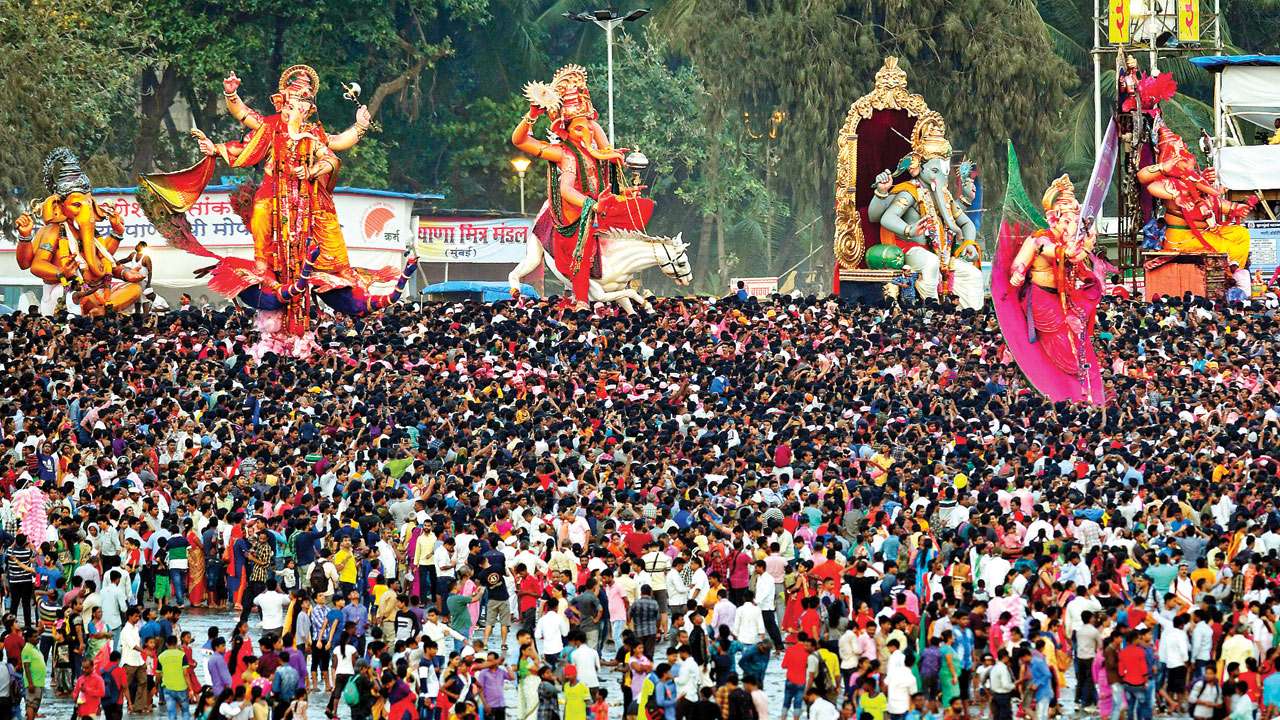

Ganpati festival

 ‘Social changes brought about by secular forces are duly reflected in culture in course of time. That has been happening in the case of Hinduism,’ wrote Jain , DNA

Like the monsoon clouds making their way across the coasts and hinterland, bringing thunder and bolts of lightning in their wake, the draft New Education Policy 2019 too is set to create more storms. 
Draft Policy papers are moving through committees and panels of our legislative system. What is missing, say domain experts, are secular principles that will impoverish the learning experience. 
In the age of ‘sabka saath, sabka vikas’, secularism and the Nehruvian order deserve a closer look as Girilal Jain, the revered former editor of The Times of India, does in The Hindu Phenomenon published in 1994. 
He goes beyond immediate policies to the role of the state in promoting Hindu civilisation. “The secularist-national position is that the Indian state embodies an ideal and is there to serve it; that while it is a creature of the Constitution, it is above the people; that in our multi-religious society, there is no other choice. In the Hindu view, the state has to be an expression of the Hindu ethos and personality. Such a state cannot either discriminate against any religious group or seek to impose a uniform pattern on the inhabitants...but the state would see itself as an instrument for the promotion of Hindu civilisation,” wrote Jain in the opening chapter titled ‘The Civilizational Perspective’. (Read DNA Opinion 28-6-19)
He makes the point that secularism and non-alignment were both central to the Nehruvian framework. “We opted for the policy of non-alignment with a visible anti-Western bias because we took a parochial view of our civilisation and wrongly defined the nature of the state in independent India...If non-alignment has meant the isolation of India from the true centres of powers in our era, the concept of secularism has meant the moral disarmament of Hindus,” wrote the former editor.
He added, “Pakistan and China could not have posed the kind of threat they have to our security if we had made common cause with the West and the Muslim problem would not have remained wholly unresolved if we had not mis-defined the nature of the Indian state.”
Girilal Jain’s understanding of Indian history and the Nehru era is wide and deep. “The Nehru structure stood mainly on three pillars in conceptual terms – socialism, secularism and non-alignment – and these concepts have been interlinked. Nehru’s was an integrated worldview. As such, it is only logical that if one of them becomes dysfunctional, the others must get into trouble. In my opinion, they have,” he wrote, with candour that was a hallmark of his writing.
In recent years, the word ‘secularism’ got tagged as ‘pseudo-secularism’, with national leaders challenging secularism. As Jain explained, “It does not follow that Nehru’s secularism was phoney; but it does mean that it was lame. To borrow the Chinese phrase, it did not walk on two legs. It wobbled on one, though Muslims provided him a crutch in the shape of electoral support, which facilitated his and the Congress party’s stay in power.” 
What is the significance and importance of secularism in the Nehruvian framework and in the scheme of Hindu civilisation? “Two points have to be made,” wrote Jain, adding, “The first is that Hinduism is tolerant, and therefore, secular. This is valid and it is sheer dishonesty or naivete to suggest, as is being widely suggested these days, that Hinduism can admit of theocracy. That is a Muslim privilege which no one else can appropriate.”
“Secondly, the dominant concern of the Hindus over the last 200 years has been with achievements in the secular realm – education, trade, industry, equality with the British before independence…This does not mean that Hindus have recognised once again, as they did in the past, that the secular realm has to be secured if a culture and a civilisation has to flourish. Swami Vivekanand emphasised the importance of secular achievements and so did Sri Aurobindo.”  
“Social changes brought about by secular forces are duly reflected in culture in course of time. That has been happening in the case of Hinduism,” highlighted Jain. “It is not being Semitized and it cannot be Semitized as a result of deliberate design on the part of some individuals or groups. But from being a confederation of ways of life, it has had to move towards being a federation…only a secular and modern intelligentsia could have presided over these changes. The task would have been beyond the reach of traditional elites. That is the true significance of secularism. It may be called the ‘midwife of Hindu nationalism’.”
“The concept of secularism and the secularization process have, of course, not been a Hindu monopoly. Members of other religious groups have also pursued them but essentially as individuals,” observed Jain. “Muslims as a group, have certainly shunned the concept as well as the process to the extent they can in a larger modernizing, and therefore, secularizing society. This is evident from the rapid expansion of traditional mosque-attached madrasahs (schools), opposition to one common civil code and adherence to the Shariat. Faith can never be a private affair for most Muslims. As political parties and leaders have to woo them as Muslims. This has produced a backlash of which the Ramjanmabhoomi issue has become one expression.” 
Reading The Hindu Phenomenon is not just a tribute to the insights of Girilal Jain but also understanding where secularism, as a Constitutional beacon, stands today.
The author is a researcher, writer, journalist and communications consultant

Sunday, July 14, 2019

Nehru as a proponent of Hindu Civilization - Raju Mansukhani

How Hindu was Pandit Nehru

Girilal Jain’s writings focus on India’s first Prime Minister as a proponent of our civilisation


Hindu

 Could Nehru, in the post-Partition years, review and restate his basic position on Hindu-Muslim cultural synthesis? This calls for a fresh debate

The political legacy of Jawaharlal Nehru, as India’s first and longest-serving Prime Minister, continues to be debated in and out of Parliament, election speeches of politicians across the country and on endless TV studio panel-discussions. 
In The Hindu Phenomenon posthumously published in 1994, Girilal Jain one of India’s finest editors, plumbed the depths of Nehruvian legacy to reveal facets of the former PM’s intellectual framework.  
“Nehru’s role in the modernization of India is well known. There is however another face of Nehru which places him, even if indirectly, among the proponents of Hindu civilization. This, of course, is not one of Nehru’s prominent faces. He rarely allowed it to come to the fore,” wrote Jain.
“Nehru struggled to discover the soul of India as no other public figure did. His intellectual background led him to take a synthetic (aggregationist) view of Indian culture, though on a more careful reflection, it should have been possible for him to recognize, on the one hand, its integral unity founded on yoga, of which the Veda itself is a fruit, and, on the other, its capaciousness on the strength of the same boundless yogic foundation which placed no limit on the freedom of the human spirit. Inevitably this synthetic view of Indian culture led him to accept the theory of Hindu-Muslim cultural synthesis. The fact of Partition must have provoked some doubt in his mind. He was too sensitive and honest an individual not to be shaken by so traumatic a development,” analysed Jain, in whose view the self-renewal of Hindus had been ongoing since the early 19th CE.
Could Nehru, in the post-Partition years, review and restate his basic position on Hindu-Muslim cultural synthesis? “No political leader in his position could afford to do so. And if it was too late before Partition, it was certainly worse after Independence when he was charged with the task of covering up the wounds inflicted by the Muslim League,” wrote the former Times of India editor, with empathic and admirable insights. 
“Three of Nehru’s speeches deserve attention,” Jain pointed out. “At the convocation of Aligarh Muslim University on 24 January 1948, he said: ‘I am proud of India, not only because of her ancient, magnificent heritage, but also because of her remarkable capacity to add to it by keep the doors and windows of her mind and spirit open...there is a continuing synthesis in India’s real history and the many political changes which have taken place have had little effect on the growth of this variegated and yet essentially unified culture...How do you feel about this past? Do you feel that you are also sharers in it and inheritors of it and, therefore, proud of something that belongs to you as much as to me? Or do you feel alien to it and pass it without understanding it...we are trustees and inheritors of this vast treasure...You are Muslims and I am a Hindu. We may adhere to different religious faiths or even to none; but that does not take away from that cultural inheritance that is yours as well as mine’.”
Jain felt, “It is inconceivable that Nehru could be so naïve as to believe even vaguely that educated Muslims could possibly regard themselves as ‘sharers and inheritors’ of the cultural heritage he was speaking about. In fact, it would be reasonable to infer that he said what he did precisely because he knew that the opposite was true.” Nehru’s poser to the audience was in effect a political-cultural paradox of the 1940s. 
On April 9, 1950, at the inauguration of Indian Council for Cultural Relations, Nehru said, “Culture, if it has to have any value, must have a certain depth. It must also have a certain dynamic character…the individual human being, race or nation must necessarily have a certain depth and certain roots somewhere. They do not count for much unless they have roots in the past, which past is after all the accumulation of generations of experience… Otherwise you become just pale copies of something which has no real meaning to you as an individual or as a group.” 
Jain pointed out that Nehru’s “emphasis on roots, depth, past must come as a surprise to all those who are not familiar with this little known face of Nehru. It must also raise the question why he did not develop this theme and indeed why he kept this face of his, by and large, so well covered?”  
On February 22, 1959, delivering the Azad memorial lecture Nehru said, “When Islam came to India in the form of political conquest, it brought conflict; it encouraged the tendency of Hindu society to shrink still further within its shell. Hence the great problem that faced India during the medieval period was how these two closed systems, each with its strong roots, could develop a healthy relationship…In India, slowly a synthesis was developed. But before this could be completed, other influences came into play.” 
Girilal Jain commented, “The addresses quoted do not contain any action programme. Nehru spoke often of the need for ‘national integration’. But if he ever defined what that called for by way of change among Muslims in practical terms, I am not aware of it…his policy of secularism did not provide, even in theory, for a cultural synthesis. It sought to by-pass the civilizational-cultural issue altogether.” Now, this calls for fresh debate. 
The author is a researcher, writer, journalist and communications consultant
Friday, July 5, 2019

The Hindu Dissent - 11

The Hindu dissent~II

To emphasise their distinctiveness, the Muslims of Bengal evolved a new language with sprinklings of Urdu and Arabic words instead of the Sanskrit based language of the Hindu Bengalis and started preparing text books using that language by using their control on primary school education. Educational grants and scholarships were utilised to favour the Muslim students in particular to redress the imbalance in the progress of education among the two communities.

Chhanda Chatterjee | Kolkata | 
The Congress High Command at this time was busy trying to secure the unfettered control in the provincial ministries, where it had won an absolute majority i.e. the Hindu majority provinces, by staying away from ministry formation to pressurise the British into pruning the control given to the Governor over the working of these ministries in the Act of 1935.
In the process it lost the chance to combine with the Krishak Praja Party of Fazlul Huq and keep Muslim League out of power in the province. Congress attempts to woo the Muslims into the party’s fold through the Muslim mass contact programme rather exacerbated the dormant conflicts of the Hindus and the Muslims and roused the Muslim League into a vigorous defence of the interests of their own constituents with the full cooperation of the KPP. The communalization of the province had its roots in these complex developments and not in bhadralok contempt for their Muslim cohorts. The Muslim ashraf probably had no less contempt for their atrap co-religionists, but they were quick to grasp the implications of the extended franchise granted in the Act of 1935 to the lower rungs of Muslims, the increase in the number of rural constituencies for Legislative Assembly seats and the necessity for mobilising support in the Union Boards and District Boards from the rural Muslim voters concentrated in the districts of East Bengal. The Muslim mass contact programme of the Congress roused them to action and the leaders from ashraf background did not delay in approaching the atrap masses concentrated in the villages.
To emphasise their distinctiveness, the Muslims of Bengal evolved a new language with sprinklings of Urdu and Arabic words in stead of the Sanskrit based language of the Hindu Bengalis and started preparing text books using that language by using their control on primary school education. Educational grants and scholarships were utilised to favour the Muslim students in particular to redress the imbalance in the progress of education among the two communities. The Secondary Education Bill sought to liberate secondary education from the control of Calcutta University and wanted to vest it in a new Board where the nominees of the provincial government or ex-officio members would hold sway. The Calcutta Municipal Amendment Act sought to bring the Calcutta Corporation under the control of the Muslims through the introduction of a separate electorate for the Muslims. The ultimate aim of the Bill was to reserve jobs for the Muslims, which Fazlul Huq as Mayor had attempted but failed to achieve in 1935 through the intransigence of Congress councillors. The enforcement of the Communal ratio in the services and the embargo on the appointment of Hindus till the Hindu-Muslim ratio was brought at par also created a deep sense of frustration among the educated Hindus. Huq now became a captive in the hands of the Muslim League. All Huq’s oratorical skill was now directed to implementing the Muslim League agenda in every sphere of administration. This brought the clash of interests of the middle classes of the two communities in the open. Mohammad Shah has called it a ‘struggle within an elite group, between those in power (the dominant Hindus) and those seeking it (the nascent Muslim middle class). As Congress was not a communal organisation it could not speak in favour of Hindus in particular.
The non-committal attitude of the Congress brought the Hindu Mahasabha into action in the province. The Hindu Mahasabha president, Savarkar, started visiting Bengal since 1939 and held the All India Hindu Mahasabha session in Calcutta in December 1940. Dr Syama Prasad Mookerjee, who had left the Congress in 1939 following the party’s decision to quit office in protest against the British Government’s unilateral decision to involve India as a belligerent in the Second World War without consulting the Ministries, offered his services to Savarkar. He toured the countryside along with BC Chatterjee and drew up a list of grievances after the manner of the cahiers de doleances, drawn up by the leaders of the Third Estate on the eve of the French Revolution and submit the report during the All India Hindu Mahasabha session in December 1940. Thus while the Muslim League started opening local offices all over the villages in East Bengal, officially announced the formation of the Muslim National Guard in the Lucknow session of the Muslim League in 1938 and started organising the Muslims from the mosques, the Hindu Mahasabha too took care that the Hindus of Bengal were not taken unawares. They organised gymnastic societies under the aegis of various organisations like the Arya Vir Dal, the Mahavir Dal, the Bharat Sevasram Sangha, the Hindu Mission and above all the Rashtriya Swayam Sevak Sangha. Thus the ground was being prepared for a head-on collision between the two communities. Congress withdrawal from the provincial ministries in protest against the involvement of India in the Second World War by the Viceroy’s diktat spruced up the Muslim League’s sagging fortunes and Jinnah could manipulate the two heavyweight Premiers from two Muslim majority provinces, Sir Sikander Hyat Khan and Fazlul Huq into proposing and seconding the Lahore Resolution, which floated the idea of Pakistan for the first time.
The resolution proposed two ‘Independent States,’ one on the west and other on the east with contiguous territories. This was also the time when the Bengal Provincial Muslim League had been secretly working on a plan of a greater Bengal including the Bengali speaking areas of Singhbhum, Manbhum and Assam. The scheme known as the Bangasam scheme was expected to provide the Bengali Muslims with ample lebensraum for unfettered expansion.
Chief Minister Fazlul Huq’s sudden rift with Jinnah in September 1941 opened new vistas for a Hindu-Muslim understanding when the Krishak Praja Party headed by Fazlul Huq formed an alliance with its staunch rival, the Hindu Mahasabha, led by Dr Syama Prasad Mookerjee. The latter, who had been dubbed as an ‘arch communalist’ by HarunOr-Rashid, a renowned historian from Bangladesh, had been given a clean chit on that count by Fazlul Huq, who had been in touch with Syama Prasad since his boyhood days in course of his legal articleship with Syama Prasad’s father, Sir Ashutosh Mukherjee. The renowned KPP leader Abul Mansur Ahmad recounted Fazlul Huq’s statement in that respect in his well known reminiscences, Amar Dekha Rajnitir Panchas Bachhor (p. 224). However, the poison of communalism had already invaded the Muslim pschyche in Bengal. Bengal had already experienced the terrible Dacca riots of 1941. Dacca city had become divided into two warring zones since then and the people of one community were always scared to trespass into the zone of another. They had become very sensitive on the questions of music before mosques or cow sacrifice during korbani. Police firing inside the Jame Masjid in Kishoreganj in Mymensingh on 24 October 1942, killing several people put matters beyond repair. People renamed the mosque ‘Shahidi mosque’ and blamed the Hindu District Magistrate Banerjee for it. Syama Prasad was already irritated with the Governor and the Viceroy on several counts. These were the years of the Second World War.
The Japanese were advancing fast towards India. Burma had already been taken. But the British lacked the resources to offer a vigorous resistance. They therefore decided to resort to a scorched earth policy in the coastal districts on the Burma border by removing all means of transport and all food from these districts. Medinipur district was the worst affected as it fell victim to an attack of cyclone in October 1942 and the District Magistrate delayed relief to punish the Congress rebels of the Quit India Movement. Syama Prasad realised that it was time for him to quit and submitted his resignation in November 1942.

Thursday, July 4, 2019

The Hindu Dissent - 1

The Hindu dissent~I

The Communal Award of 1932 was not a big shot in the arm for the Bengal Muslims as is usually made out; if it reduced the Hindus to a statutory minority, it had also put a check on the percentage of the Muslims. The European Group was allowed an edge at their expense in order to keep them perpetually dependent on the Europeans for support.

Chhanda Chatterjee | Kolkata | 


Many of us in West Bengal are not aware of the long and tortuous chain of events that led to the carving out of this new state out of the erstwhile state of Bengal, which went into Pakistan. Had it not been for the tireless efforts of Dr Syama Prasad Mookerjee, the whole of Bengal would probably have slipped into East Pakistan. The partition of the province was not a thing which was to the liking of either Syama Prasad or the Hindu Mahasabha, the organization which he represented at this time. As late as the debates in the Bengal Legislative Assembly on 19 September 1946 following the gory incidents of August 1946, which go under the name of the Great Calcutta Killing, Dr Syama Prasad Mookerjee, the president of the All India Hindu Mahasabha, had been looking for “a plan which will enable the vast majority of Hindus and Muslims to live under circumstances which will give freedom and peace to the common man”. He wanted to scrap “the false and foolish idea of Pakistan or Islamic rule.”
During the 1940s, the Hindu Mahasabha had ardently propagated Akhand Hindusthan or the indivisibility of India. But in May 1947 the same Dr Syama Prasad Mookerjee had written to the Viceroy that Hindus “must not be compelled to live within the Moslem State and the area where they predominate should be cut off.”It would be interesting to explain this turn around by analysing the political developments preceding this date under the dual scheme of provincial autonomy and the Communal Award of 1932 foisted on Bengal through British imperialist machinations.
The Hindus and the Muslims, the two dominant religious communities of Bengal had been living side by side for several centuries. One obvious reason for this might have been that the vast majority of the Bengali Muslims had not been taught to regard their Hindu counterparts as the “other,” as both the Hindu as well as the Muslim peasants were equally exploited by their rentier landlords in an evenhanded manner. That the economic divide in the East Bengal countryside between the Hindu landlords and their Muslim tenants coincided with their religious divide did not make much difference as Bengali Muslim society at this time was hopelessly differentiated between the ashraf and the atrap. Ashrafs were usually of Persian or Arabic origin, who had come to Bengal in the train of the Muslim conquerors or were posted by the ruling Muslim chiefs in Delhi with administrative assignments. They were usually Urdu-speaking and kept their atrap brethren at a distance. Ashrafs were often paid by jagirs for their administrative services. These estates were later converted into zamindaris. Most of them also enjoyed pompous designations like Raja, Nawab etc. and regarded the low caste peasants, whether Hindu or Muslim, with great contempt. British rule in Bengal did not immediately interfere with this social differentiation till about the last quarter of the nineteenth century.
The widespread commercialization of agriculture which came in the wake of British rule brought about a new stratification among the peasants. A section of the peasantry, who could retain their hold over a part of their product after meeting their obligations to the zamindar and the moneylender, could often sell them at a profit. Thus emerged a handful of affluent cash crop cultivators among the peasantry from about this time. Some of them aspired after ashraf status and started sending their children to schools. With it was heralded the dawn of a community consciousness among the madrasa educated literati. Revivalist movements like the Tariqa-i-Muhammadiya, the Wahabis, the Fara’idis and the Ta’aiyyunis created an impact exactly among these people. Although differing in details they all served to promote an Islamic identity among the Muslim peasantry and arrested their assimilation with the local inhabitants belonging to other belief systems.
According to the Fara’idi doctrine a fara’id was to observe the five fundamentals of Islam (bina’ al-Islam) like reading the Kalimah (the article of faith), offering namaz five times a day, fasting during ramzan, paying poor tax (zakat), and performing haj (pilgrimage to Mecca). The poor, however, were exempted from the last two. The Fara’idis tried to restore tawhid (belief in one God) and tried to stop unIslamic practices. They insisted that congregational prayers of Jum’ah and Id could not be held except in misr al jami (a city where the city lord or Amir and the Qazi orJudge were appointed by a Sultan, enjoying the sanction of Islamic law). All places other than that were dar-ul-harb, a country of the enemy. The pure way of life, they believed, would help them regain their political power and restore the dar ul Islam (rule of Islam). The Tariqah I Muhammadiah, propagated in Bengal by the Patna caliphs, Maulanas Inayet Ali (1794- 1858) and Wilayet Ali (1791-1835) succeeded in mobilizing a large number of recruits from the Bengal districts like 24 Parganas, Jessore, Faridpur, Pabna, Rajshahi, Malda and Bogra for the purpose of retrieving the holy land from the incursions of Sikh infidels on the Afghan border. This Tariqah movement was sometimes confused with Wahabbism of Shah Waliullah (1703-62) of Delhi. Maulana Karamat Ali’s Ta’aiyyuni movement too had the same goal of winning over the Muslims of Bengal from the mire of local customs. Although the Fara’idis did not support jihad, unlike the Wahabbis, yet ultimately they all converged in propagating jihad to rescue the converts from the evil contact of infidel religion. This urge for uniting against the infidels at one point helped to bridge the gap between the ashraf (elite) and the atrap (plebian) among the Muslims. During his non-cooperation movement of 1920, Gandhi therefore chose to make Khilafat one of the main issues to draw Muslim sympathy against the British. This, however, yielded a bitter crop of communal consciousness and resulted in fostering separatism among the Muslims. Mullas and maulavis from this time were given absolute freedom to talk about politics. The result was widespread communalization of politics.
Chittaranjan Das had rightly identified the sore point of the rising Bengali Muslim educated middle class as “essentially a struggle for power by the marginal sections of the educated classes of Bengal society”. The Bengal Pact of 1923 tried to address their long standing grievances about music before mosques, free performance of cow sacrifice during Eid and opportunities of employment by conceding a quota of 55 per cent of the available jobs. It was also agreed that appointment of Hindus would be put on hold for some time till the communal ratio in employment came at par. But the Cocanada Session of the Congress in December 1923 refused to abide by these guidelines as the swarajists were merely a handful. After Chittaranjan’s death his policies were thus thrown to the winds.
The Communal Award of 1932 was not a big shot in the arm for the Bengal Muslims as is usually made out; if it reduced the Hindus to a statutory minority, it had also put a check on the percentage of the Muslims. The European Group was allowed an edge at their expense in order to keep them perpetually dependent on the Europeans for support. For the Hindus the Poona Pact had done the maximum mischief by taking out a large chunk from their share. The Pact between Sir A H Ghuznavi, a member of the Central Legislative Assembly and an ex-minister of the Bengal Government under the diarchy, and the Maharaja of Burdwan in 1936 took note of all these factors when they agreed upon a 50/50 share. Fazlul Huq’s Krishak Praja Party tried not to lock horns in a bitter fight with the Congress in the countryside. Rather it tried to resolve the economic conflict between the Hindus and Muslims by abolishing the Permanent Settlement which had given such obnoxious powers to the zamindars on the cultivators. Its other agenda was to resist the intrusion of the Muslim League and its communal politics into the Bengal countryside. But the Congress High Command’s decision not to accept office and Sarat Bose’s priority to the release of detenus over the economic programme of the KPP wrecked the possibility of a Praja-Congress government.